2012 in review
The WordPress.com stats helper monkeys prepared a 2012 annual report for this blog.

Here’s an excerpt:
The new Boeing 787 Dreamliner can carry about 250 passengers. This blog was viewed about 1,100 times in 2012. If it were a Dreamliner, it would take about 4 trips to carry that many people.
Philip Sletten patents Water Clarifying Unit, 1959
Filed under: James Dalager, Phyllis (Sletten) Dalager, Sletten, Winthrop |
 Leave a Comment
 James Dalager’s father-in-law, Phyllis’ father Philip O. Sletten of Winthrop, Minnesota was an engineer at the milk processing plant in Winthrop from the 1940s through the 1970s when he retired. Of the many remarkable things he did, perhaps the least known is his 1959 U.S. Patent of a Milk Clarifying Unit. Essentially, Philip found a way to make the process of drying milk more efficient by recycling the water vapor from the dehydrating milk, purifying it, and reusing that water in the boiler.
Click and see United States Patent US2910182. Pretty cool stuff, especially if you’re an engineer.
Theodore and Sophie (Dalager) Ogdahl: A History
Filed under: Barsness Township, Dalager, Julia (Dalager) Chilson, Ogdahl, Pope County, Sophie Ogdahl, Theodore Ogdahl |
Leave a Comment Theodore Ogdahl was born in Dodge County, in south central Minnesota on December 8th 1868. He was the son of Thore (Ogdahl) Thoresen and Astri Olsdatter. Three years later his father and others, with their covered wagons and teams of oxen, started out for the northwest. They homesteaded in Kandiyohi County in the area of Sundberg and Norway Lake. They had not traveled far from Dodge County but travel in a covered wagon pulled by oxen was slow. Theodore grew to manhood in this area.
Sophia Oline Dalager was the second daughter of Ingeborg and Hans Dalager, a prominent farmer in the Glenwood, Minnesota area. Sophia was born March 10, 1874 on the farm in Barsness township where she grew to a adulthood. Pioneer life was hard and Sophia learned to work hard. She was sixteen years old when Theodore and Sophia were married.
The following letter was written before Sophia and Theodore were married. It was written to Julia Dalager, a cousin, who lived in Webster, S. D. Her sister Anna Sophia, had married John McCarlson July 28, 1888 and Sophia was anxious to get a picture of the couple. The letter was written in Norwegian and was translated into English by Estelle Grinde on September 6, 1998.
October 10, 1889
Dear Cousin,
Now since it is a long time since I have heard from you so now I will take pen in my hand and send you a few lines. I will first tell you that we are all well and healthy and I wish the same for you. I would like to hear from you again. We shall now have threshers tomorrow and now we are busy with that. Jennie is not home as she teaches school north of Lake Minnewaska. She will come home to visit in about two weeks when there is confirmation. Then Hannah Ronning, Emma Billehuus and Peter Gilbertson and many more will be confirmed. I wish that you could be here then.
You must greet Sophia from me and tell her I would like a portrait or picture of her and her husband and I will have a picture of my husband and me when you come. I do not have much news to tell you when I am so busy. A friendly greeting to everyone from us all with special greeting to Sophia.
Write soon in return. Ask Sophia to send me a portrait of her and her husband and I will have hers also.
Good By, Remember well and bare in mind
A good true friend is hard to find
But when you have found one just and true
Change not the old one for a new.
Excuse my poor writing-I am in such a hurry.
By, By
From your Friend
Sophia Dalager, Glenwood, Minn
Theodore and Sophia were married in the Barsness Lutheran church on July 14, 1890 with Rev. M. G. R. Skaar officiating. Sophia’s attendants were Jennie Dalager Grove and Gunild Ogdahl Braaten. Theodore’s attendants were Lars Holten and Ole Ogdahl. The day had started out with a lovely summer rain in the morning. In the afternoon the sun had come out and chased the clouds away. It seemed that the entire country side gathered at the church. Many came afoot while others drove in buggies or wagons with spring seats on them.
Following the wedding ceremony a reception was held at the Dalager farm. Following this reception Mr. And Mrs. Ogdahl went at once to Norway Lake to Theodore’s parent’s farm where another reception was held. When guests arrived at the Ogdahl farm a man stood at the gate playing selections as the guests filed into the house. The gallant groom carried his bride over the threshold. The festivities, which began with an elegant dinner, lasted well into the night.
Theodore and Sophie (Dalager) Ogdahl: Raising a family in Pope County
Filed under: Barsness Township, Dalager, Hans Dalager, Ogdahl, Pope County, Sophie Ogdahl, Theodore Ogdahl |
Comments (1) 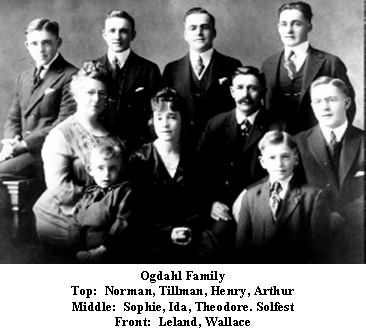 Theodore and Sophia farmed in the Norway Lake area for a short time before returning to Barsness Township. In 1891 Sophia and Theodore purchased the place later known as the John Hagen farm where they lived and farmed for twelve years. In 1892, two years after they were married, lightening struck and killed one of their horses or the team. However, they could not afford to replace the horse or horses so Theodore bought a team of oxen that were much cheaper and slower. He used this team until he could afford a team of horses. Sophia served as Postmistress of Barsness post office until it was moved to an inland town in Barsness township called Cheesetown.
Following this they moved to the Hans Dalager farm where they resided for seven years.
Glenwood Herald
March 20, 1903
Hans Dalager of Barsness Township has leased his big farm to his son-in-law Theodore Ogdahl for a term of six years at an annual rental of $1,100.00. Mr. Dalager will most likely move into town. He feels that he has performed his share of hard labor on the farm and is therefore entitled to a few years of retirement and rest.
Hans Dalager died March 23, 1910.
Following Hans’s death, Theodore and Sophia decided to move onto another farm where they lived for about 28 years. In the fall of 1916 their residence burned down. Sophia and Theodore built a new home on this farm.
Theodore and Sophia had nine children. Following is a brief description of each.
- Henry Theodore, born June 7, 1891, Married Inez Smith in Minneapolis, Minn on Sept 20, 1916.
- Arthur William, born July 30, 1893, Married Helen Iverson in Weyburn Sask, Canada on June 18, 1917.
- Tillman Martinus, born April 21, 1895, married Irene Larson March 2, 1917 in Minneapolis, Minn.
- Ida Amanda, born July 28, 1897, married William Scrimgeour June 1925 in Glenwood, Minn.
- Solfest Oliver, born October 12, 1899, married Svea Myrtle Victoria Ronge November 21, 1924.
- Norman James, born September 29, 1902, Married Alice Jacobson in Farwell, Minnesota.
- Wallace Clifford, born November 11, 1907, Married Mabel Schillo in Glenwood. Minn.
- Julian Dalager, born May 16, 1910, lived 2 days.
- Leland Ellsworth, born September 9, 1913, Married Esther Glaspey in Iowa.
When the Ogdahl boys were young they lived on a farm that was near a small lake or slew. It was a good place for the boys to play and learn to swim. Highway 104 south of Glenwood now goes through the slew. The Bentrud farm was on the east side and the Ogdahl farm was on the west side.
Theodore & Sophia Ogdahl spent 47 years of their married life farming and had always been members of the Barsness Lutheran Congregation. Mr. Ogdahl served on the school board in district 40 for 12 years and as director of the Farmers Elevator for 22 years. He was also a director of the Federal Land Bank for 16 years and was the first shipper out of Glenwood for the Glenwood Shipping Association.
Mrs. Ogdahl served as treasurer for the Barsness Ladies Aid for 15 years and was the first woman to serve as chairperson of school district 40. Sophia also served as the historian for the Barsness Ladies Aid.
Sophie (Dalager) Ogdahl: Good years remembered
Filed under: Dalager, Ogdahl, Sophie Ogdahl, Theodore Ogdahl |
Leave a Comment The following are memories of Sophia and Theodore by Wanda Megers Wagner. Wanda is the daughter of Willy Dalager who is Sophia’s half brother.
As a young person Wanda worked as a hired girl for aunt Sophia Ogdahl. Sophia had the fanciest home that Wanda had seen at that time because she had a chandelier. The house also had a back stairway and a front stairway. Wanda was Sophia’s hired girl and therefore worked in the house. She would set the table at night with all the plates up side down so no ‘critters’ would get on the plates. That is what Sophia told Wanda. There was a ‘dumb’ waiter in the house. After the meal Wanda had to put the butter, milk, and everything that needed to be cool on the ‘dumb’ waiter. It was then lowered to the basement, which was cooler in the summer. The table was usually set for four, which would be for Aunt Sophia, Uncle Theodore, Wanda, and one hired man. All of the boys were gone. Theodore and Sophia had been married for 30 to 35 years and they were still on the farm.
Wanda said that Sophia could fry the best eggs. She would swirl them around in the pan and then with a flip of the pan, she would turn them over so that the eggs were fried on both sides, “over easy’.
Sophia dressed well and always wore a fancy hat. Wanda was about 12 or 13 years when she worked for Sophia. She thought Sophia was really a neat person.
One of Wanda’s daily duties was to wash the cream separator. One of the hardest jobs for Wanda was to wash clothes. Sophia did not have any of the newer washing machines and washed clothes by hand on the scrub board. Wanda remembered that her parents had a gasoline-operated washing machine but Sophia did not have one. Sophia and Theodore had their own 32-volt electric generating system but no washing machine. An electric system like this would only operate a few light bulbs.
Mrs. Norman (Alice) Ogdahl had the following memories of Sophie and the Ogdahl family. Alice said that Sophie would never sit down unless she had some handwork to do. Sophie would always give each family the same thing. If she was giving pillow cases, they all got the same gift. Sophie was an ambitious woman. She sold her had work and also exhibited it at the county fair. She always came back with first prizes.
Alice Ogdahl said that Sophie was good at selling and would have liked to have been a sales woman. However, she never got to be a sales lady because of the farm work and she was busy raising a large family.
Sophie (Dalager)Ogdahl writes to her sister Julia (Dalager) Chilson
Filed under: Dalager, Julia (Dalager) Chilson, Ogdahl, Pope County, Sophie Ogdahl, Theodore Ogdahl, Webster |
Leave a Comment The following is a letter written by Sophia after their 40th wedding anniversary in 1930. It is written to her cousin Julia Dalager Chilson in Webster, S.D. The Sophia mentioned in the letter is Julia Chilson’s sister.
Dearest cousin Julia,
Received your fine letter and big gift. (Tusini Tak). Julia it is entirely too big a gift. May God bless you and all your dear ones? Greet Andrew and family.
Oh! It would have been grand if you and Andrew could have been with us. It was the first time since I got married and moved away that all my sisters and Karl have been gathered.
We have so much to be thankful to God for. I got married as a child who lost my mother. Had no one to go to. But God had given us strength and given us so many nice children and there have been dark day, sickness. But always every cloud has had a silver lining and now letters, gifts, from nearly every state from friends and relatives so all we can say, “May God bless them all and may we all meet in Heaven.”
I presume you knew Mr. & Mrs. Rudy Dalager went to Norway some years ago. They live in California. I think his address is 783 E. Clairmont St., Pasadena, Calif.
How nice you could visit Sophia’s children. She left a grand family didn’t she?
Say when you go up north next year come and visit us. We love to have you.
Thanking you again for this big gift and greet Herman (Julia’s husband) and the Peters (Julia’s daughter’s family).And so I shall close with a tight hug and a big kiss to our darling cousin Julia.
Lovingly Theo and Sophia
Did you get the Tribune? Write when you want to hear from us dear.
Sophie and Theodore Ogdahl’s final years in Glenwood as seen in news clippings
Filed under: Dalager, Glenwood, Ogdahl, Pope County, Sophie Ogdahl, Theodore Ogdahl |
Leave a Comment When Theodore was 70 years old, Sophia and Theodore moved into Glenwood March 1, 1938 where they planned to spend their retirement years. However, they continues to be active.
Theodore began to work for his son Wally Ogdahl at the Glenwood Hatchery. He thoroughly enjoyed his office duties and continued to work there well into his eighties. Theodore enjoyed visiting, especially in Norwegian. Because he had a rupture he was not able to walk very far.
Sophia continued to take care of their house along with much community and church work. She took in boarder’s and roomer’s during the depression years of the thirties.
Pope County Tribune
July 15, 1940
50th Wedding Anniversary
Friends and neighbors of Mr. And Mrs. Theo Ogdahl of Glenwood gathered last Sunday in large numbers at the Barsness church to help this much-respected couple celebrate their 50th wedding anniversary. Services had been announced for 11:00 o’clock at the church and those who attended first went to the church to worship. Rev. E. O. Barsness preached the sermon. The day was bright with sunshine, much like the day 50 years ago when they were married.
After the service the assembly repaired to the basement of the church where a meal was served by the ladies aid. Many of those who attended had brought well-filled baskets for the dinner.
At 2 PM the assembly entered the church to the strains of the Lohengrin wedding march with the bridal party at the head. Here a program consisting of musical numbers and talks was given. Rev. Barsness presided and after introductory remarks called on Rev. J. Linnevold of Glenwood. Rev. Barsness stated that Sophia’s and Theodore’s wedding was the first conducted in the Barsness church.
The remainder of the program consisted of talks by G. H. Moen of Glenwood who had been present at the wedding fifty years before, by Julia Solverud Knutson, sister of the bride, by Ida Scrimgeour, a daughter and a declamation by Elizabeth Scrimgeour, a grandchild. Musical numbers were given by Erling Wollan, Eleanor and Lorraine Ogdahl, daughters of Arthur Ogdahl, the Barsness male octet, Deloris Ogdahl daughter of Henry Ogdahl and by three year old Paul Ogdahl, son of Solfest O. Ogdahl. Wallace Ogdahl spoke for the family and at the end of the program Mrs. Ogdahl, the bride, read a poem.
Present at this golden wedding were three of the attendants of fifty years ago. They were Lars Holten, Mrs. Kittel Braaten and Jenny Grove. Ole Ogdahl could not be present so his place was taken by Nels Ogdahl in the procession.”
Pope County Tribune
July 19, 1945
Mr. and Mrs. Theodore Ogdahl of Glenwood enjoyed the rare privilege of observing their fifty-fifth wedding anniversary with a number of their children and their families, on Sunday, July 15th. They were married married 55 years ago in the Barsness Church. Five years ago they celebrated their golden wedding day in the Barsness church when the entire countryside joined in the festivities. This time they celebrated the event with a dinner at the Rex Café.
Present for the occasion was their son, Leland and his wife of Independence, Iowa; their daughter Ida, Mrs. W. A. Scrimgeour, her husband and daughter of Brownton, Minn; their son, Solfest and his wife and daughter, and with him Mrs. Henry Ogdahl and daughter and a daughter of Arthur Ogdahl and her husband, all of Minneapolis; Norman Ogdahl and wife and son of Farwell and Wallace Ogdahl and family of Glenwood. Mrs. J. O. Grove, a sister of Sophia, of Glenwood was also present at the dinner. Unable to be present for the occasion was their son, Arthur Ogdahl of Frontier, Saskatchewan, Canada; Henry Ogdahl in Alaska; and Tilman Ogdahl in Oregon.
Mr. and Mrs. Ogdahl were very happy to have their grandson, William Alexander Scrimgeour, who is in the air corps and is in training in Denver, Colorado call them over long distance telephone and add his congratulations. The connections were very good and it was very easy to hear him.
Pope County Tribune
December 3, 1948
Mrs. Theodore Ogdahl visited over Thanksgiving with Mr. And Mrs. Leland Ogdahl at Independence, Iowa. She also visited with relatives in the Twin Cities on the same trip. While in Minneapolis she visited another great grandson, a son of Mr. And Mrs. Lowell Ogdahl of Minneapolis. This is the 16th great grandchild that Mrs. Ogdahl has had the pleasure of welcoming. She has 22 grandchildren.
Pope County Tribune
December 9, 1948
Those who came to help Theodore Ogdahl celebrate his 80th birthday on Sunday afternoon were Mr. & Mrs. Norman Ogdahl and family of Farwell, W. C. Ogdahl and family, Jennie Grove and Mr. And Mrs. John Norberg of Glenwood.
Pope County Tribune
March 10, 1949
Mr. And Mrs. Theodore Ogdahl had the great joy of having their children come home during the weekend for a family reunion and also to help them celebrate their birthdays. Mr. Ogdahl was 80 years of age a short time ago while Mrs. Ogdahl is celebrating her 75th birthday this month. All their children were home except Tillman who is on the west coast. The children who were home were Mr. And Mrs. Leland Ogdahl and two children of Independence, Iowa who came on Friday. On Sunday Mrs. Inez Ogdahl (wife of Henry Ogdahl who had passed away) of Minneapolis came in company with Mr. and Mrs. Arthur W. Ogdahl and Mr. and Mrs. Solfest O. Ogdahl. Present also were Mr. and Mrs. W. A. (Ida) Scrimgeour and daughter of Brownton, Minn., Mr. and Mrs. Norman Ogdahl and son of Farwell, and Mr. and Mrs. Wally Ogdahl and family of Glenwood. In the afternoon Mrs. Julius Grove, Mrs. Ogdahl’s sister, was also present.
The entire group was out to the Sunset Beach Hotel on Sunday where they enjoyed a very fine dinner. In all there were 21 present. They had a light lunch late in the afternoon at the Ogdahl home before they departed. It has been some time since the Ogdahls have had so many of their children at home at one time and it was a great treat to them.
Pope County Tribune
July 6, 1950
Mr. and Mrs. Theodore Ogdahl of Glenwood will hold Open House on Sunday, July 16th between the hours of 2 PM and 5 PM at the Glenwood Lutheran Church parlors, in observance of their 60th wedding anniversary.
Minneapolis Sunday Tribune
July 9, 1950
GLENWOOD, MINN—Mr. And Mrs. Theodore Ogdahl will celebrate their 60th wedding anniversary Friday, July 14. Open house will be held next Sunday from 2 to 5 p.m. in the Glenwood Lutheran Church.
Glenwood Herald
July 14, 1950
A milestone that few married couples have the privilege of reaching, the sixtieth wedding anniversary, will be observed by Mr. And Mrs. Theodore Ogdahl of Glenwood at the Glenwood Lutheran church on Sunday, July 16th between the hours of 2 P.M. and 5 P.M. A hose of friends and relatives are expected to attend.
Sophia Dalager, second daughter of Ingeborg and Hans Dalager and Theodore Ogdahl, son of Astrid and Tore Ogdahl were married in the Barsness Lutheran church on July 14, 1890 by Rev. Skaar. Their attendants were Jenny Dalager Grove, and Gunild Ogdahl Braaten, Ole Ogdahl, the groom’s brother and Lars Holten. The reception was held at the new Hans Dalager home just built that summer. A delicious dinner and supper was served to about 200 relatives and friends. On the 16th of July, two days later, another reception was held at the Tore Ogdahl home in Kandiyohi County. To this union eight boys and one girl was born. The eldest, Henry, passed away November 15, 1945; living are: Arthur of Saskatchewan, Canada, now of Minneapolis; Tillman of Portland, Oregon; Ida (Mrs. Scrimgeour of Brownton, Minnesota; Solfest of Minneapolis; Norman of Farwell; Wallace of Glenwood and Leland of Independence, Iowa. There are 26 grandchildren and 16 great grandchildren.
Sophia died March 1, 1951, at the age of 77 years,less than a year after they had celebrated the 60th wedding anniversary. Funeral services for Sophia were held at the Glenwood Lutheran Church at 2:00 P. M. Friday, March 23. 1951. Theodore lived six more years. He died August 4th, 1957 at the age of 89 years. Both Sophia and Theodore are buried in the Barsness church cemetery.
Bibliography
- Glenwood Herald
- Glenwood Historical Library
- Lavilla Dalager Peterson
- Alice, Mrs. Norman Ogdahl Sr.
- Norman James Ogdahl Jr.
- Pope County Tribune
Hans Dalager: Lavilla (Dalager) Peterson remembers her father
Filed under: Dalager, Hans Dalager, Lavilla (Dalager) Peterson |
Leave a Comment My aunt Lavilla has related a number of memories to me about her father, Hans, some siblings, and other people of interest. They’re all in the next few posts. Following shortly after are more memories by Lavilla’s daughter, Wanda, my cousin.
Note: When writing this information up later, I was left with several questions which you’ll see in the texts. Please contact me if you have answers to any of these questions. My contact information can be found by clicking the “About DFH” link above.
Lavilla remembered how Hans had admired the new horses someone had brought to the farm. Hans had had many horses and knew a good horse when he saw one. She remembered someone saying that Hans would have 7 hired men during the harvest season. He ran many outfits for cutting grain and threshing so he had to have many horses. Each grain wagon required two horses but when they plowed, there were 4 horses on each plow. Did he thrash out of stacks or use bundle rack to haul directly to the thrashing machine as was done later? ________________________ One year Lavilla said she had to drive a binder. She followed Herman’s binder. Therefore, if she had any trouble he could help her. That was the year that her school board came to get her signature for the next year while she was cutting grain with the binder. She said that was a ‘binding’ contract. Sometimes the fields were a long way from home. Therefore when they quite for the day, they would unhitch the horses and they would drive the horses home. She would have to walk behind the horses to control them with the reins and she said she did not like to do that. Sometimes this could be a rather long distance.
Tillie (Dalager) Ogdahl: Lavilla (Dalager) Peterson remembers
Her oldest sister was Tillie who was born Sept. 26, 1888. She married Anton Ogdahl October 21, 1909. They had a family of 4 boys and 3 girls. Children came regularly about every two years. When they were first married they lived on the homestead place, where Ralph lives now. Amelia was living on the homestead with the younger children and as the older children got married they would live with Amelia and later find their own place. To make things go, they had hired men and women and ran a lot of land.
Amelia stayed on the farm until she was 80. She also had a house in town which Helen helped her buy. For the last 10 years of her life Amelia lived in town with Tillie who was a widow by then. Amelia was not feeling well at this time but she would talk about going back to the farm. Her children would take her back to the farm where they would wheel her around in her wheel chair. How many years had Amelia lived on the farm?________
Lavilla said that Tillie loved to cook and keep house. She did a lot of sewing. She would take old garment and make clothes for her children. If you went to her house you were sure to be invited for coffee and something to go with the coffee. When Lavilla was growing up she would visit her older sister Tillie quite often. When she visited Tillie Lavilla would help with the children. She was sure that she had held all of Tillie’s children. Tillie’s husband Anton died of T B. on July 21, 1934 at the age of 52 years. Robert Petersonwould like to stop in at Tillie’s home on the way home from country school. She always had something good to eat.
Cora (Dalager) Anderson: Lavilla (Dalager) Peterson remembers
Filed under: Cora Dalager, Dalager, Hans Dalager, Lavilla (Dalager) Peterson |
Comments (1) Cora was married to Adolph Anderson. Adolph was a farmer and their farm was in the Garfield area. Adolph was killed in an accident. What kind of accident? _______ ______________________Cora was a teacher before she was married. All the girls in the second family were teachers except Tillie.
Their sister Alma died from an appendicitis when she was about 7. Lavilla said that she remembered Karl, my dad, coming to visit Amelia. Lavilla thought every thing was fine between them.
Lavilla did not remember much concerning the death of Hans. She was 7 years and Lucille was 5. She remembered that someone told them to get up because Papa had died. They kept the body in the home in those days until the funeral. She remembers seeing Hans lying on the bed.
 Dalager Family Histories